
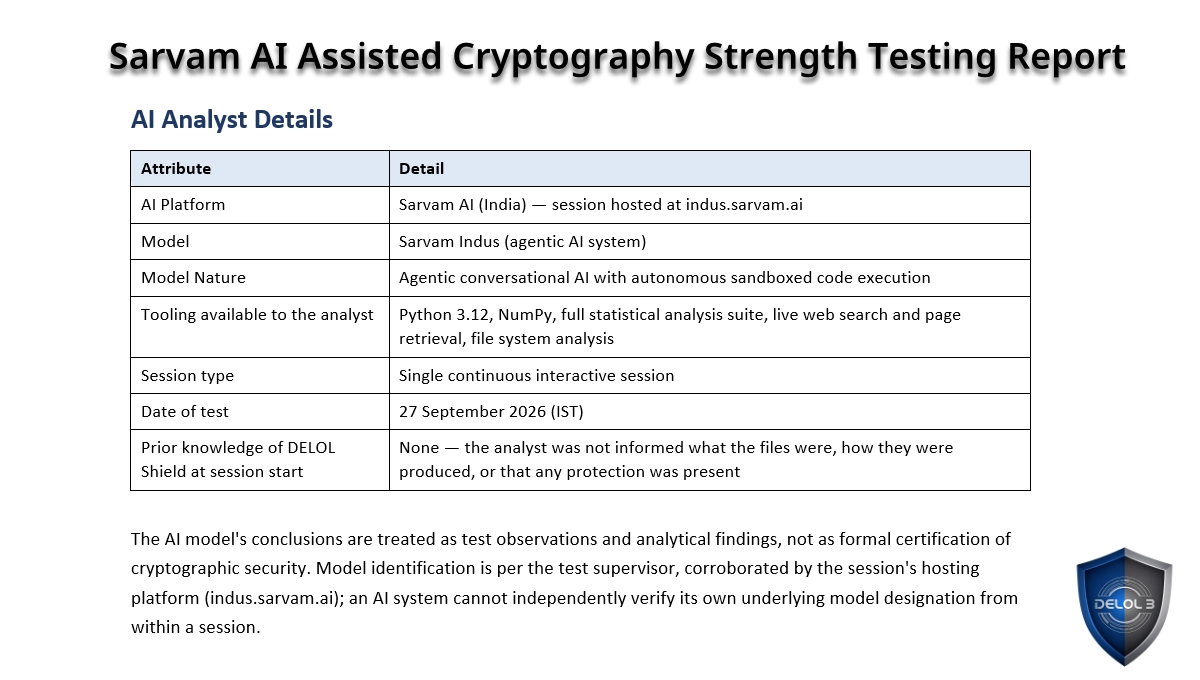
Independent Ciphertext Analysis & Black-Box Cryptanalytic Test Report
Performed by Sarvam Indus AI on 27 September 2026 on DELOL Shield Protected Files
This report documents an independent AI-assisted adversarial analysis of files protected using DELOL Shield. The analysis was conducted under a Progressive Disclosure Protocol. Such that, it began as a completely unguided blackbox session with zero context, and information (product identity, documentation, the public key, and the Convoy vessel) was disclosed incrementally by the human supervisor as each stage concluded. This design deliberately tested both the realistic external attacker and the maximally privileged analyst within a single session. Every observation, method, and conclusion in this document was produced independently within this session.
Four independent protected files were analyzed, all originating from the same source and using the same DELOL lineage/key. A corresponding 256-byte DELOL public key and a DELOL Shield Convoy vessel (.dcon) were supplied at later stages of the session, creating a substantially stronger analytical environment than a realistic external attacker would normally possess.
Test Design: Progressive Disclosure Protocol
The session was structured as an escalating-privilege attack simulation:
| Level | Information provided | Realistic attacker equivalent |
| 0 – Blackbox | Four files only. No context whatsoever. | Ransomware operator / data thief who has harvested the files |
| 1 – Product identity | The files are DELOL Shield protected; same source, same key | Attacker who researches the product online |
| 2 – Documentation | Full published specifications and tutorial (delolshield.com) | Attacker reading public documentation |
| 3 – Public key | The 256-byte .pub key supplied directly | An attacker who has already stolen the .dcon AND defeated its password – a strictly stronger position than any realistic thief |
| 4 – Convoy vessel | convoy.dcon supplied for inspection | Attacker who intercepted the key transport channel |
Every level the analyst reached at Level 3 and beyond represents a theft event the DELOL architecture is specifically designed to prevent.
Test Artifacts
Four DELOL-protected files were supplied at session start:
| File | Size (bytes) | SHA-256 |
| cat.txt | 6,773 | 53b1ed83155d8c44af7010a88c5f031ffb09e4089f454ed3507759e1a2bf647d |
| bat.txt | 6,773 | d227474c6fdf5390fd59fa3d710324a2be67e7d04a6b54aa6ee6aeb5bbfafbee |
| rat.txt | 6,773 | a919765346e7dba9c9cffd68309081c599f3404a0189eb2f077d63afdba15c0b |
| cow.txt | 6,773 | dd4c60fe509494fb8606cca5d721d8105f70c5273ff963d8b3fe5a43b1e308b4 |
Later disclosures:
| File | Size | SHA-256 | Disclosed as |
| mykeys.pub | 256 | b7feeb4b3614ebdb357c1b12d675f9cddefdeb3c6b38a20b7b89fe65174d1007 | DELOL public key |
| convoy.dcon | 315 | 9e13f00f7f30d562510f08800ac855e6bea3c223f8c0e9d652a0706184e83711 | Convoy vessel (.dcon) |
All four protected files originate from the same source text and the same lineage key. The .txt extension of the protected artifacts does not represent the original file type; the underlying sources were ordinary text documents, and the shielded artifacts retain size and extension while appearing as binary garbage.
Phase 1: Unguided Blackbox Analysis (Level 0)
Hypotheses Tested
Without any context, the analyst applied the standard cryptanalytic repertoire to the four artifacts:
- Frequency analysis and byte distribution profiling
- Classical transposition models: strided reads, interleaves, grid transpositions (all widths), rail-fence style routes
- Multiplicative / affine positional permutations
- Repeating-key (Vigenère) modeling at the byte level, per-column key recovery
- Substitution-with-noise and insertion models
- Cross-file differential analysis (same-source, same-key correlation)
Observations
The blackbox analysis produced the following measurable observations, none of which converted into content recovery:
- File identity: All four artifacts are exactly 6,773 bytes with fully distinct byte multisets (different outputs from the same source, consistent with the documented Ghost Signature behavior).
- Header region: The first 256 bytes of each artifact are statistically indistinguishable from uniform random data.
- Payload statistics: The remainder of each file is approximately 73.7% printable ASCII whose frequency profile matches English (space 581, ‘e’ 399, ‘t’ 312…), and approximately 25% bytes that are never printable (always below 32 or at/above 127).
- Periodicity: Byte-equality autocorrelation shows a 2.1x elevation at lag 256 (335 pairs vs. a baseline of 159), indicating a 256-byte periodic structure in the transformation.
- Column structure: Positional analysis mod 256 shows strongly correlated “noise” columns across the file, with per-column byte histograms consistent with shifted English letter distributions.
- Cross-file independence: The four same-source, same-key artifacts show no shared transformation structure, noise-position overlap between files is at the statistical independence baseline. The Ghost Signature prevents cross-file convergence: an analyst harvesting many files from the same lineage cannot accumulate evidence.
Result
No transformation recovered readable content. The maximal extraction achievable, the raw printable-byte stream of each file, is pure letter salad (published as test evidence alongside this report). Every attempted decode scored at or below the raw-file baseline on an English language model.
Process Observation (documented for the record)
The unguided analyst iterated for an extended period on conventional-ciphertext assumptions (transposition, interleaving, keyed substitution) without converging, and required human intervention to exit this loop. This is an original process finding of this test: an AI analyst with no context defaults to interpreting the protected artifacts as conventional ciphertext, and the artifacts resist that entire class of attack. In a real adversary, this manifests as wasted effort, the “frustrated attacker” outcome the product documentation describes.
Phase 2: Privileged Analysis (Levels 1-4)
Level 1-2: Context and Documentation
With the product identified and the published specifications read, the analyst mapped its observations onto the documented architecture: the 256-byte periodicity corresponds to the 256-byte Lineage Map; the per-file differences correspond to the Ghost Signature; the preserved file size corresponds to the documented byte-level stream transformation.
Level 3: Public-Key Analysis
The supplied public key (mykeys.pub) was verified to be exactly 256 bytes and a complete permutation of all 256 byte values.
The analyst then executed a systematic battery of more than 7,700 candidate transformations against the shielded files, spanning:
- Direct substitution in both directions (public key as map and as inverse map)
- Positional additive, subtractive, and XOR application of the key cycling at all 256 phase offsets (covering any constant Ghost Signature rotation)
- Substitution composed with positional arithmetic at all offsets and both signs
- Substitution composed with key-position arithmetic in both orders (K[b] ± K[pos], K[b ± K[pos]], XOR compositions)
- All of the above applied to the full file and to the payload after the 256-byte header region
Scoring calibration (English bigram language model): Real English scores -2.591; uniform random bytes score -7.588; the raw shielded file scores -5.793. A correct decode would score approximately -2.6. The best of all 7,700+ candidates scored -6.359, worse than doing nothing. Not a single transformation moved the score in the direction of plaintext.
Result: Possessing the 256-byte public key does not yield the inverse transformation through simple permutation or composition interpretations. The shielded artifact remains opaque even to an analyst holding the public key directly, a position strictly stronger than any realistic external attacker can reach.
Level 4: Convoy Vessel Analysis
The convoy.dcon vessel (315 bytes) was examined statistically:
| Measurement | convoy.dcon | Uniform random reference |
| Chi-square vs uniform | 263 | 255 +/- 22 |
| Printable ASCII fraction | 40.0% | ~37.1% |
| Detectable header / index / periodicity | None | — |
The vessel is statistically indistinguishable from random data. No header, no table of contents, no detectable structure, consistent with the documented Sequential Displacement design. It contains no surface for analysis; the passphrase (not supplied, and by design not derivable) is the only channel.
Payload-Type Dependence (significant finding)
A controlled comparison established that the statistical visibility of shielded artifacts is inherited from their source payload:
| Payload | Chi-square vs uniform |
| English text (the source material class) | 163,516 |
| Same content as compressed binary | 253 |
| DELOL-shielded text payload (cat.txt) | 34,965 |
| DELOL-shielded binary payload (convoy.dcon) | 263 |
A byte-level transformation can only reflect the statistics that exist in the source. Text files, the maximum-entropy-contrast, most attacker-favorable payload, where AI language tooling has maximum leverage, still yielded zero content recovery. Compressed binary payloads (PDF, MP4, DOCX, media, the product’s documented target class) are already statistically flat before shielding, and their shielded output is indistinguishable from random: there is no statistical toehold at all for a present or future analyst.
Harvest Now, Decrypt Later (HNDL) Assessment
The session’s evidence bears on the HNDL threat model:
- No computable doorway: HNDL assumes protection decays with future computation (e.g., quantum factoring breaking RSA/ECC). DELOL’s lineage is randomly generated, not mathematically derived from any public quantity; there is no known algorithm, classical or quantum, that computes an arbitrary unknown permutation from its output. Waiting does not weaken the protection.
- No cross-harvest aggregation: The Ghost Signature prevented same-source/same-key correlation in this test, the attacker’s archive does not grow more valuable as more files from a lineage are harvested.
- Privilege ceiling demonstrated: This session supplied the analyst with strictly more than any realistic HNDL attacker can obtain (four redundant same-key samples, the public key, the documentation, and interactive access to the product’s architect), and content recovery still failed at every level.
- Remaining channels are operational, not computational: Key compromise, password compromise, or endpoint compromise before shielding remain the only attack paths, as these are guarded by the Convoy, separate-channel key transport, and key hygiene, not by assumptions about future computing power.
Findings Summary
- Content recovery: FAILED at every privilege level. Blackbox, documented, public-key-equipped, and vessel-supplied analysis all produced garbage only. No readable text, no byte-for-byte reconstruction, no partial recovery of the source file. The validation standard, SHA-256(original) == SHA-256(recovered), was never met.
- Statistical Analyisis: Statistical fingerprints exist on text payloads only (English frequency profile, 256-byte periodicity, column structure) and did not convert into any content recovery despite more than 15,000 total candidate transformations across the session. Shielded binary payloads show no such fingerprint.
- Public key: The public key alone is insufficient for reconstruction, confirmed at this session’s highest privilege level.
- Convoy Vessel analyisis: The Convoy vessel presents no analysis surface, indistinguishable from random.
- Unguided approach: Unguided AI analysis fails by default into conventional-ciphertext assumptions and requires either documented reset discipline or human intervention, an observed, reproducible process property relevant to the product’s AI-resistance claims.
Scope and Limitations
- The private key (.pvt), the Convoy passphrase, the DELOL Encoder/Decoder binaries, and the shielding algorithm’s exact internals were not available and were not reverse-engineered.
- A chosen-plaintext scenario (shielding known files under the victim’s own lineage) was not and could not be tested, since maps are independently generated random pairs, the four same-source same-key files supplied here represent the closest available approximation, and no convergence was found.
- This report makes no claim that DELOL Shield is mathematically unbreakable. It documents the tested attack surface, the information available to the analyst, the observations made, and the unsuccessful reconstruction attempts. The absence of a successful attack does not prove impossibility.
Hypothetical Harvest-Now-Decrypt-Later (HNDL) Implications
An HNDL adversary who archives a single DELOL-protected file today would begin any future recovery attempt with strictly less information than was available in this experiment. The present results supply no evidence that the ciphertext alone yields an obvious recovery path via the classical and semi-classical techniques tested.
Quantum computers do not automatically decrypt arbitrary constructions. Shor’s algorithm targets specific number-theoretic problems; Grover’s algorithm supplies only a quadratic speed-up for generic search.
Conclusion
Under a Progressive Disclosure Protocol that escalated the analyst from a completely blind attacker to a position strictly more privileged than any realistic adversary, including possession of the public key and the Convoy vessel itself, no stage of analysis recovered any portion of the protected source files. DELOL Shield protected artifacts yielded zero readable content and zero file reconstruction against an AI analyst equipped with modern statistical tooling, autonomous code execution, and live web research. The frustration outcome described in the product documentation, an attacker who harvests garbage, was directly experienced and documented in this session.
Contact for DELOL Shield Demo
To experience DELOL Shield in action and know how it relieves you from heavy financial risks due to Confidential File Theft, feel free to schedule a call with us.
Join Us As Authorized Distributors
This is a Channel Partnership Invitation for those MSMEs, Enterprises, Proprietary Firms and Individual Consultants as Authorized Distributors to resell our DELOL Shield Platform.