
Adversarial Cryptanalysis and File-DNA Reconstruction Analysis
Performed by GPT-5.6 Luna on 26 September 2026 on DELOL Shield Protected Files
This report documents an AI-assisted adversarial analysis of files protected using DELOL Shield The investigation was deliberately conducted in two phases.
Four independent protected files were available, all originating from the same source and using the same DELOL lineage/key. You can download those Test Payloads.
A corresponding 256-byte DELOL public key was also available to the analysis.
This created a substantially stronger analytical environment than a realistic external attacker would normally possess.
Phase 1: Assumption-Driven Testing
The initial investigation approached the protected artifacts using assumptions commonly applied to conventional cryptographic ciphertext.
Multiple conventional cryptanalytic hypotheses were tested, including substitution, XOR, repeating-key relationships, positional permutation, transposition, RC4-like interpretations, Ghost Signature transformations and other straightforward byte-level models.
These approaches did not recover the source file.
However, Phase 1 also exposed an important methodological problem:
The protected artifacts were being interpreted primarily as conventional ciphertext rather than as transformed file DNA.
Phase 2: Evidence-Driven File-DNA Analysis
The investigation was subsequently reset around the actual characteristics of the samples and the documented DELOL architecture.
The samples were recognized as originally protected TXT files created using Windows Notepad and subsequently renamed from .txt to .dat solely for upload and analysis.
The investigation then shifted from the question:
“Can the ciphertext be decrypted?”
To the more fundamental question:
“Can the original file itself be reconstructed from its transformed DNA?”
The current investigation has not reconstructed the original file byte-for-byte. This report therefore makes no claim that DELOL is mathematically unbreakable.
Instead, it documents the tested attack surface, the information available to the analyst, the observations made from the protected file DNA, the unsuccessful reconstruction attempts, and the remaining questions requiring further cryptanalytic investigation.
Purpose of the Test
The purpose of this investigation was to examine DELOL Shield from the perspective of an analyst who possesses protected artifacts but does not possess the creator’s private lineage material.
The primary research questions were:
- Can the protected file be interpreted as conventional ciphertext?
- Can the supplied DELOL public key be directly exploited to reconstruct the source?
- Can multiple protected versions of the same source reveal the transformation?
- Does the Ghost Signature expose a recoverable relationship?
- Does the protected file retain exploitable positional or statistical information?
- Can the original file be reconstructed from the transformed byte DNA?
- What does the investigation imply for a realistic Harvest Now, Decrypt Later (HNDL) scenario?
- What additional testing should be performed before making stronger security claims?
Test Environment
AI Analyst – ChatGPT through GPT-5.6 Luna model
The AI model was used as an analytical instrument for:
- Byte-level reasoning
- Statistical interpretation
- Cryptanalytic hypothesis generation
- Cross-sample comparison
- Transformation-model testing
- Adversarial reasoning
- Reconstruction strategy development
The AI model’s conclusions are treated as test observations and analytical findings, not as formal certification of cryptographic security.
Test Artifacts
Four DELOL-protected files were analyzed:
- car.dat: 1,684 bytes
- cart.dat: 1,684 bytes
- metro.dat: 1,684 bytes
- rat.dat: 1,684 bytes
The files are documented in the test record and available for download as mentioned earlier in the introduction.
A 256-byte file representing the corresponding DELOL public key was also supplied.
Important Test-Data Clarification
The .dat extension of the four test files does not represent their original file type.
The files were originally DELOL-protected TXT files.
They were renamed from .txt to .dat because the protected TXT artifacts could not otherwise be uploaded for analysis.
The original source files were created using Windows Notepad.
This distinction is important because the investigation initially treated the artifacts too much like arbitrary ciphertext.
The actual test object was:
A DELOL-transformed TXT file whose underlying file structure originated from an ordinary Notepad-created text file.
DELOL Architecture Relevant to the Test
DELOL’s documented architecture describes a 256-byte Lineage Map, a 4-byte Ghost Signature and a corresponding public/private key relationship.
The documentation states that the private key is consumed by the Encoder as the Lineage Map during protection and that the matching public key is required by the authorized Decoder for recovery. It also describes the Ghost Signature as a 4-byte value associated with an individual shielding operation.
DELOL documentation also describes repeated shielding of the same source as producing binary-unique outputs and describes the system as operating on file bytes rather than being restricted to visible text.
These documented characteristics were treated as architectural context rather than assumed proof of security.
Phase 1: Assumption-Driven Testing
Initial Analytical Model
The first phase approached the artifacts according to conventional cryptanalytic assumptions. The working question was effectively:
What conventional encryption or byte transformation could have produced this ciphertext?
This was intentionally broad and adversarial.
Classical Transformation Tests
The following classes of hypotheses were investigated:
- Fixed XOR
- Repeating-key XOR
- Caesar/ROT transformations
- Vigenère-like transformations
- Direct byte substitution
- Inverse byte substitution
- Positional permutation
- Transposition
- Interleaving
- RC4-like interpretation
- Ghost Signature XOR variants
- Ghost Signature addition/subtraction variants
- Byte rotations
- Simple position-dependent transformations
- Fixed relationships between corresponding bytes across samples
None of these approaches produced a defensible reconstruction of the original file.
Phase 1: Key Interpretation Tests
- The supplied 256-byte public key was examined as a possible byte permutation.
- The key contains all 256 possible byte values exactly once.
- This makes it naturally interpretable as a permutation or Lineage Map.
- Two obvious possibilities were therefore investigated:
- Protected byte → public-key substitution, and:
- Public-key inverse substitution → source byte.
- Neither interpretation reconstructed the original file.
- The key was also examined as a possible positional transformation.
- Again, no direct reconstruction resulted.
This was an important negative finding because it demonstrated that:
Possessing the 256-byte public key does not, by itself, reveal an obvious direct byte-for-byte inverse transformation through simple permutation interpretations.
Phase 1: Cross-Sample Analysis
The four files were produced from the same source and same DELOL lineage/key. This created an unusually powerful analytical opportunity.
The samples can conceptually be represented as:
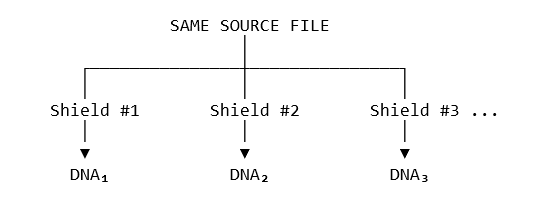
Corresponding-byte comparisons showed low direct byte equality despite strong similarities in aggregate byte distributions.
This was inconsistent with a simple fixed substitution or a straightforward common XOR stream.
The changing four-byte prefixes were also consistent with the documented Ghost Signature mechanism.
Phase 1: Result
Phase 1 did not recover the original file. More importantly, Phase 1 revealed that the conventional ciphertext model was insufficient to explain the observed artifacts. This led to a fundamental methodological reset.
Phase 2: Evidence-Driven File-DNA Analysis
Conceptual Reset
The central question was changed from:
How do we decrypt this ciphertext?
To:
What happened to the original file’s DNA?
This distinction is fundamental, since a file is more than its visible content as its complete DNA includes:
- Every byte
- Byte ordering
- Character encoding
- Line terminators
- Structural markers
- Metadata
- Binary relationships
- Offsets
- Embedded structures
- Application-specific syntax
Therefore, successful recovery must reconstruct the complete original file byte stream, and not merely readable content.
Phase 2: Observed File Structure
The four files are each 1,684 bytes and their first four bytes differ between shielding operations:
- car.dat: 47 43 95 D9
- cart.dat: AE 60 24 46
- metro.dat: D0 39 76 DD
- rat.dat: D2 2F CE 1D
This is consistent with a per-operation 4-byte Ghost Signature. The samples also exhibit a pronounced distinction between an initial 256-byte region and the remaining file body.
The first region has substantially different statistical characteristics from the subsequent region. This observation is significant but does not by itself establish the precise purpose of the 256-byte region. And so, possible interpretations require further testing.
Phase 2: The Transformed Text DNA
The subsequent file body retains substantial characteristics associated with textual data. The byte population includes large quantities of:
- Alphabetic characters
- Spaces
- Punctuation
- Carriage-return/line-feed values
- Other values associated with ordinary text
However, the original positional relationships are substantially disrupted. This produces an important observation:
The protected file does not simply present as an independently generated random byte sequence. Significant statistical characteristics of the source file remain observable while the original structural organization is disrupted.
This observation motivated the use of the term file-DNA transformation during the investigation.
Windows Notepad as a Controlled Source
The fact that the source files were created in Windows Notepad provides useful structural information. The analyst knows that the source is ordinary textual file data and can therefore reason about:
- Character populations
- Spaces
- Punctuation
- Line terminators
- Text encoding
- Expected file structure
This represents additional information available to the analyst. Nevertheless, the original file has not yet been reconstructed.
Critical Finding: Text Recovery Is Not the Objective
A major correction to the initial analysis was made during Phase 2. The objective is not:
Recover the original English text.
The objective is:
Recover the original file itself.
For the TXT samples, a successful attack must therefore produce a file whose complete byte sequence is identical to the original.
The correct validation is:
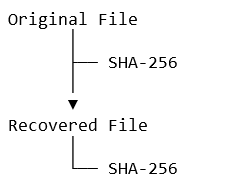
Where:
SHA-256 (original) == SHA-256 (recovered)
And, ideally, direct byte-for-byte comparison confirming zero differences.
A file that merely displays the same text is insufficient.
Why This Distinction Matters for Other File Types?
DELOL is a file-level protection mechanism and is not limited to TXT files. The documented system addresses binary files and describes protection of PDFs, presentations, videos and other file assets. The same recovery criterion therefore applies universally.
PDF Files
Recovering visible pages is not sufficient. The complete PDF byte stream must be reconstructed.
Video Files
Recovering playable video is not sufficient. The original container and complete byte stream must be reconstructed.
Audio
Recovering audible content is not sufficient. The original audio file must be reconstructed byte-for-byte.
Other Binary/Data Files
The complete binary structure must be recovered.
Thus:
The real security question is whether the protected file’s original byte DNA can be reconstructed.
Current Reconstruction Status
At the conclusion of the documented testing:
Complete original-file reconstruction has NOT been achieved.
The investigation has therefore not reached a cryptographic victory condition. This statement is intentional.
The absence of a successful reconstruction does not mathematically prove that reconstruction is impossible.
It means:
The transformation has not yet been explained sufficiently to reconstruct the original file using the tested methods.
Contact for DELOL Shield Demo
To experience DELOL Shield in action and know how it relieves you from heavy financial risks due to Confidential File Theft, feel free to schedule a call with us.
Join Us As Authorized Distributors
This is a Channel Partnership Invitation for those MSMEs, Enterprises, Proprietary Firms and Individual Consultants as Authorized Distributors to resell our DELOL Shield Platform.